 Add Row
  Add
Add 


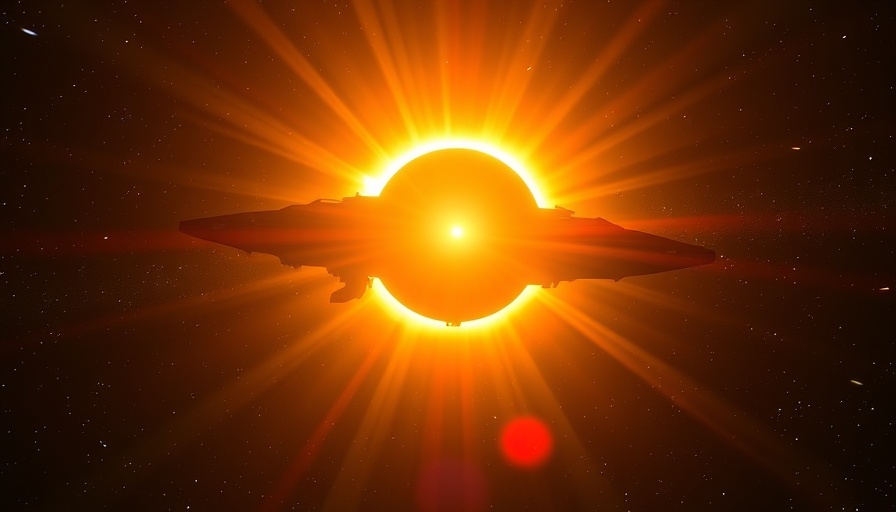
Artificial Solar Eclipse Unlocks New Discoveries
The Proba-3 mission, launched by the European Space Agency (ESA), has successfully created an artificial solar eclipse, enabling scientists to capture unprecedented images of the Sun's corona. This innovative approach uses two satellites orbiting Earth in a highly synchronized formation to block sunlight, similar to how the Moon does during a natural eclipse.
How Proba-3 Works: The Science Behind the Eclipse
One satellite, known as the Occulter, acts as a shield to obstruct the Sun's rays from reaching its counterpart, the Coronagraph. This setup allows researchers to study the corona, the Sun's outer atmosphere, which can reach temperatures of up to 2 million °C. As a result, scientists can observe solar phenomena that typically go unseen during standard observations or natural eclipses, which only last a few minutes.
Boosting Solar Research Capabilities
Before Proba-3, the corona could only be glimpsed during brief total solar eclipses—occurrences that happen sparingly and unpredictably. With Proba-3's capacity to simulate an eclipse every 19.6 hours and maintain it for up to six hours, researchers expect to yield a wealth of new data. This advancement opens new pathways for solar research, paving the way for enhanced understanding of solar storms and their potential to disrupt communications on Earth.
Catalysts of Innovation: The Tech Behind It
Collaboration among over 40 European tech firms made this ambitious mission possible. For instance, Dutch startup Lens R&D contributed sensors to track the Sun's position with remarkable precision, while Irish-based Onsemi provided sensitive light detectors to measure small shifts in the Sun's shadow. Such innovations exemplify how varied expertise in technology can come together to push the boundaries of space science.
Future Implications: What This Means for Humanity
The successful execution of the Proba-3 mission could revolutionize solar research, influencing developments in technology, telecommunications, and energy management. Understanding the corona better may also lead to improved predictions of solar activity, which is crucial for safeguarding satellite communications and power grids.
As we usher in this exciting era of solar exploration, the potential benefits are vast. Increased knowledge of solar systems not only contributes to scientific understanding but also enhances the technology that underpins modern society.


Write A Comment