 Add Row
  Add
Add 


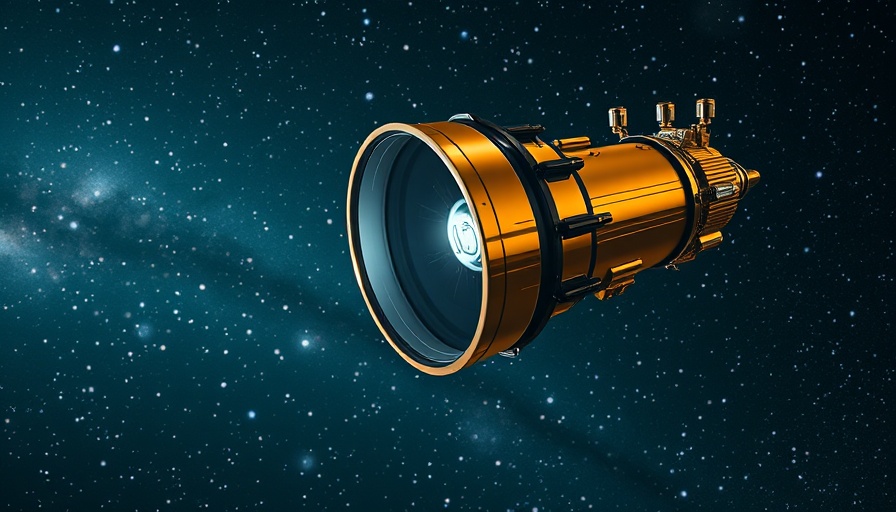
Euclid's Cosmic Discovery: Unveiling Gravitational Lenses
The European Space Agency's Euclid space telescope has recently captured significant evidence of double gravitational lenses, also known as Einstein rings, which provide crucial insights into our universe. Just weeks after its early data release, Euclid has already glimpsed 26 million galaxies, some of which are over 10.5 billion light-years away—essentially looking back in time to when the universe was still forming.
The Significance of Gravitational Lenses
Gravitational lenses occur when massive cosmic objects, such as clusters of galaxies or black holes, manipulate the path of light from more distant galaxies. This distortion creates observable arcs and rings of light surrounding the massive body. These gravitational lensing phenomena not only affirm Einstein’s theory of general relativity but also open a window to understanding dark matter's role in the universe.
Mapping the Dark Universe
The early data from Euclid represents only 0.4% of the intended survey area, yet it provides a remarkable preview of the vast cosmic terrain that Euclid aims to explore. By creating the largest 3D map of the universe, scientists expect to gain vital knowledge about dark matter, which comprises about 27% of the universe's total mass-energy content. These findings could elucidate how dark matter shapes galaxy formation and distribution.
Future Research Directions
The discoveries from Euclid are sure to spur future research initiatives focusing on dark energy and the universe's expansion. As astronomers delve deeper into the data over the coming years, we anticipate a transformative understanding of cosmic structures. Furthermore, the collaboration of various research institutions across Europe facilitates a comprehensive approach to these new discoveries.
Your Invitation to Engage with the Universe
As the Euclid telescope continues its groundbreaking work, those intrigued by space exploration and cosmic phenomena are encouraged to stay tuned for updates from ESA. Understanding these celestial mechanics could reshape our worldview, emphasizing the need for everyone to engage with astronomical communities and educational programs.


Write A Comment