 Add Row
  Add
Add 


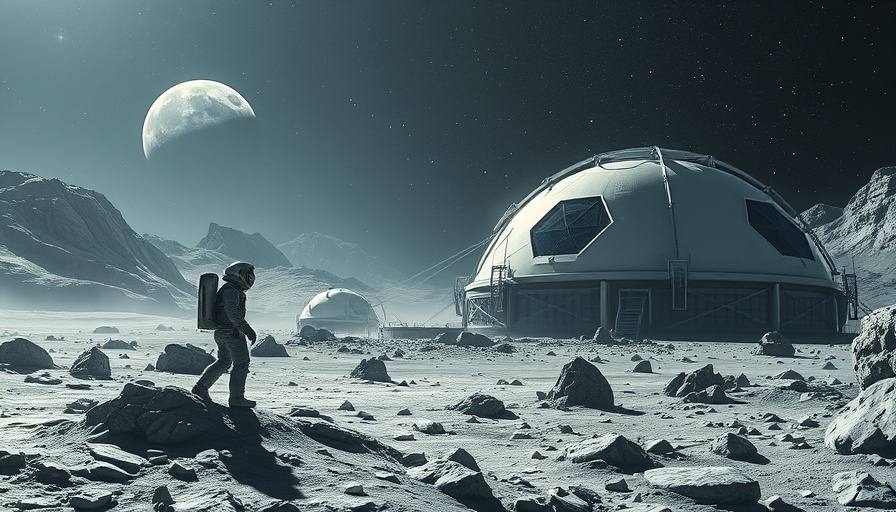
The Moon as a Renewable Energy Source
As humanity eyes expansion beyond Earth, the Moon may soon become a critical source of renewable energy. Scientists at the University of Potsdam have pioneered a process to create solar panels from "moonglass," which is made by melting artificial moon dust—also known as regolith. This breakthrough has potential ramifications for future lunar colonies, suggesting we could harness lunar materials directly in space, making solar energy more accessible and efficient.
Cutting Costs and Weight in Space Exploration
Current solar technology used in space, primarily silicon-based panels, is both expensive and heavy. Felix Lang, the lead researcher, highlights these systems reach impressive efficiency levels between 30% to 40%, but the costs often outweigh the benefits when shipping such panels into space. By contrast, designing moonglass panels on the Moon’s surface can reduce launch mass by an astonishing 99%—a significant financial benefit as we push for a sustained lunar presence.
Moonglass: A Game-Changer for Space Infrastructure
The efficiency of the moonglass solar cells currently reaches about 12%, but with further refinement, simulations indicate potential to match conventional perovskite cell efficiency. The implications are substantial; fewer resources transported from Earth mean lower overall mission costs. Researchers believe that with successive advancements, this innovation could revolutionize how we establish energy infrastructures on other celestial bodies.
Challenges Ahead for Moonglass Production
Despite the promise of moonglass technology, challenges remain, particularly in mass production outside the laboratory. Experts, such as Nicholas Bennett from the University of Technology Sydney, stress that while this marks a first successful step, scaling to a production level suitable for lunar bases requires further exploration and experimentation.
Future Prospects of Lunar Colonization
The development of moonglass solar cells represents only the beginning of high-tech solutions to support a permanent human presence on the Moon. Together with advancements like 3D printing lunar bases and extracting oxygen from regolith, these technologies could open new avenues for sustainable living on the Moon. As these innovative strategies emerge, they bolster humanity's ambition for deep-space exploration, transforming the Moon from a distant dream to a viable extension of human civilization.


Write A Comment